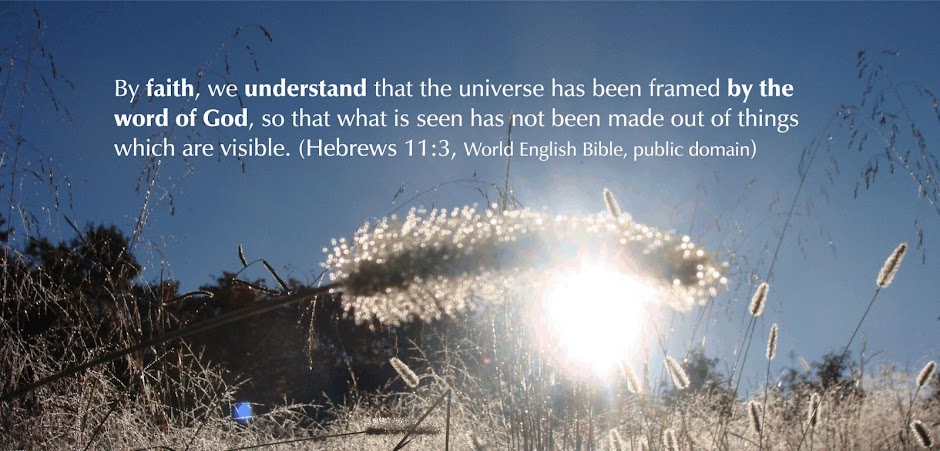
Friday, December 04, 2009

National Cookie Day!

I hear that today is National Cookie Day! Great!

In case you didn't know it, those food items that North Americans call cookies are called biscuits in the United Kingdom. For more on this use of words, see here. I'm including Canadians in "North Americans," lest there be any doubt. In the part of Canada that I am most familiar with, near Stratford, Ontario, there seems to be a Tim Hortons every kilometer or so -- they like sweet pastries there.

Thanks for reading. Don't eat too much.

Wednesday, December 02, 2009

Sunspots 237

Things I have recently spotted that may be of interest to someone else:


Science:
(sort of) Wired shows us photos of some really big mechanical devices (using device loosely -- the first one is a cargo plane).

NPR reports on experiments showing that ants are able to keep track of the number of steps they have taken away from their anthill.


Christianity:
Jan paid her tithe, and tells us what happened.

Philip Yancey has written his last column, for a while, anyway, for Christianity Today . He takes a thoughtful look at the way evangelical Christians do things, and is not altogether pleased.

Image source (public domain)

For Christ's pleasure?

Revelation 4:11, in the KJV, reads thus:
Thou art worthy, O Lord, to receive glory and honour and power: for thou hast created all things, and for thy pleasure they are and were created.

At least one worship song is based on that verse, and uses the phrase "for Thy pleasure" in the same way.

I checked the Blueletter Bible. I'm not a Greek scholar, but do report that, of the 12 different English translations given for that verse, only 3, one being the KJV, use this phrase. The rest of them say that things were created by or at Christ's will.

I also checked the Greek lexicon provided by the Blueletter Bible, and found that the KJV almost always translates the word, θέλημα (thelēma), translated as "pleasure," in Revelation 4:11, as "will." In fact, out of over sixty occurrences of the word in the New Testament, Revelation 4:11 and Ephesians 2:3, which refers to a human attitude, not God's, are the only verses where it is not translated as "will."

Perhaps it is correct to say that the universe, and the things in it, were created for Christ's pleasure, but the case is not strong. I don't think we know why we were created. We're probably not capable of understanding the reason or reasons.

Thanks for reading.

Tuesday, December 01, 2009

Comfort in hell?

One of the strangest Bible passages I have read recently is this one:

Ezekiel 32:30 “The princes of the north are there, all of them, and all the Sidonians, who have gone down in shame with the slain, for all the terror that they caused by their might; they lie uncircumcised with those who are slain by the sword, and bear their shame with those who go down to the pit.
31 “When Pharaoh sees them, he will be comforted for all his multitude, Pharaoh and all his army, slain by the sword, declares the Lord God. 32 For I spread terror in the land of the living; and he shall be laid to rest among the uncircumcised, with those who are slain by the sword, Pharaoh and all his multitude, declares the Lord God.” (ESV. This is a page that gives copyright information for the ESV.)

There is the abode of the dead, and, in Pharaoh's case, the unrighteous dead. Comforted? Really? That was so strange a phrase that I checked it with the Blueletter Bible, which gives several versions of 32:31. They all agree, so this is not a mistranslation by the ESV.

Despite the title, it is not clear that Pharaoh, in this passage, is actually in hell. (See the Wikipedia article on Sheol.)

Like a lot of other things in the Bible, I can't explain this one. Perhaps you can. I will say that, even if there is some sort of comfort in hell, that doesn't make make hell any more desirable. It should be avoided at all costs!

Thanks for reading.

Monday, November 30, 2009

Some caution about global warming

I have taken the view, over the years, that there really is such a thing as global warming, and that human activity is at least partly responsible for that. I am not, by any means, an expert on climatology, but I believe that the scientific consensus is strongly in favor of this view, based on good data.

There is a considerable amount of anecdotal photographic evidence, including changes in the polar ice caps, which is the main reason that I continue to hold to that view. But, out of fairness, I point out that some recently released e-mail exchanges between climate scientists seem to indicate that there has been some fudging to strengthen the case for data supporting global warming. If true, this is a shame. Science should be objective. It probably never has been entirely so, but, for the most part, the system has worked.

National Public Radio has a report, both textual and audio, about these e-mails, and provides an analysis of their significance.

Thanks for reading.

Sunday, November 29, 2009

Glory to God, Whose Sovereign Grace

Glory to God, whose sovereign grace
Hath animated senseless stones;
Called us to stand before His face,
And raised us into Abraham’s sons!

The people that in darkness lay,
In sin and error’s deadly shade,
Have seen a glorious gospel day,
In Jesus’ lovely face displayed.

Thou only, Lord, the work hast done,
And bared Thine arm in all our sight;
Hast made the reprobates Thine own,
And claimed the outcasts as Thy right.

Thy single arm, almighty Lord,
To us the great salvation brought,
Thy Word, Thy all-creating Word,
That spake at first the world from naught.

For this the saints lift up their voice,
And ceaseless praise to Thee is giv’n;
For this the hosts above rejoice,
We raise the happiness of Heav’n.

For this, no longer sons of night,
To Thee our thankful hearts we give;
To Thee, who called us into light,
To Thee we die, to Thee we live.

Suffice that for the season past
Hell’s horrid language filled our tongues,
We all Thy words behind us cast,
And lewdly sang the drunkard’s songs.

But, O the power of grace divine!
In hymns we now our voices raise,
Loudly in strange hosannas join,
And blasphemies are turned to praise!

This is one of over 250 of Charles Wesley's hymns, found on his page at Nethymnal. I've never heard it, but it has some words appropriate for the season.

Saturday, November 28, 2009

An example of scripture where concordism doesn't fit

Psalm 119:89 Forever, O Lord, your word
is firmly fixed in the heavens.
90 Your faithfulness endures to all generations;
you have established the earth, and it stands fast. (ESV. See here for ESV copyright information. See here for the Blueletter Bible's display of how other versions treat verse 90.)

(See yesterday's post for a discussion of concordism.)

Few people would say that this passage means that the earth doesn't rotate on its axis, or revolve about the sun, or that the sun itself doesn't move as the galaxy rotates, in spite of the literal interpretation of verse 90, which seems to say all of those things. Presumably, the Psalmist wrote in accord with the science of the time, which didn't know as much about astronomy as we think we know now. The passage is poetic, not scientific, and it still speaks to us about God's sustaining power. God established the earth, and preserves it, wherever it may go through space.

Thanks for reading.

Friday, November 27, 2009

Concordism, a barrier to Christian acceptance of science

Steve Matheson writes an important blog, entitled "An Evangelical Dialogue on Evolution." A recent post, by guest writer Jordan Mallon, strikes me as particularly important.

In this post, Mallon considers the idea of what he calls concordism, namely that "God revealed to the authors of Scripture scientific facts about the universe that could not otherwise have been known to them at the time." Mallon does not believe this, although he says it is an unexamined presupposition of many conservative Christians. Instead, he believes that the writers of the Bible were limited to their own knowledge, the scientific knowledge of the time, when writing. Why does Mallon think this? His main evidence is the question of geocentrism, the idea that the earth is the center of the universe. This was the common belief for centuries, perhaps millenia, until the 16th century. One reason that it was believed, beside the fact that the earth does appear to be fixed, and other things, such as the sun and moon, revolving around it, is scripture. Mallon lists 11 passages, all from the Old Testament, that appear to have been written by persons who believed in geocentrism.

Perhaps the most frequently discussed of those passages is one from Joshua, wherein Joshua is said to have commanded the sun and moon to stand still. I don't know what happened then. Whatever it was, it was a miracle. As the link in the first sentence of this paragraph will show, no less than Answers in Genesis, an organization that is often accused of taking the Bible too literally, does not believe that this passage teaches geocentrism. (I have posted here on the unfortunate false rumor that NASA has proved the story in Joshua is true. The fact that NASA hasn't proved it doesn't mean that it didn't happen.) Mallon's point, of course, is that the ancient writers did not write as if they had been given special scientific knowledge. As he says, "we now appreciate that God sometimes accommodates His message to the limitations of human understanding." He calls this accomodation.

Mallon draws a conclusion, namely that the first part of Genesis may also be coming to us through the filter of the scientific knowledge of the writer, and the the knowledge available to the hearers or listeners that Genesis was first presented to, and, therefore, a belief in speciation by natural selection, and perhaps even the origin of larger groups of organisms by this mechanism, may not really conflict with scripture at all.

The post by Mallon covers two other topics, almost as important. I suggest that you read his post. Thanks for reading this one.

See my next post, for a concrete Biblical example.

Thursday, November 26, 2009

Have you been thankful for your existence?

Here's a fundamental thing that perhaps you have never explicitly thanked God for -- your existence!

You exist, or you wouldn't be reading this. I exist, or at least I did on November 22nd, or it wouldn't have been written. Existence is such a fundamental fact that we seldom consider it enough to be grateful for it.

Thank you, God, that I had the chance to exist!

There's a Wikipedia article on Existence, and, trust me, it bristles with philosophical concepts.

I know that some people wish that they had never existed, and perhaps that's a legitimate wish for some people, but most of them aren't serious, or, if they are, they aren't sane. God help them. (See Job. God did help him.)

Thanks for reading! Thank God that you exist!

Wednesday, November 25, 2009

Sunspots 236

Things I have recently spotted that may be of interest to someone else:


Science:
The Boston Globe has assembled a fabulous array of photos of Mars, close-up.

Microbial Art is a web site devoted to presenting art from microbial growth.

Sports:
The Associated Press reports on a statistical study that indicates that major college men's basketball referees tend to act in ways that keep the scores close. And, yes, they do favor the home team.

Christianity:
A relatively short, but important, post, entitled "Clarifying Concepts in the Creation-Evolution Dialogue." I would say that this is must reading for Christians interested in science and in origins. God willing, I will post on this article later.


Image source (public domain)

Monday, November 23, 2009

Queen of the Orcs: King's Property by Morgan Howell

I recently read Queen of the Orcs: King's Property, the first book in a trilogy, by Morgan Howell. (Howell is a pseudonym.) Here's the Amazon page on the book.

Orc is a term used most prominently by J.R.R. Tolkien. As the Wikipedia article on the term indicates, the word pre-dates Tolkien.

There are significant differences between Tolkien's orcs and those of Howell. Tolkien's orcs seem to have been about human size, or smaller. Tolkien didn't have any female orc characters. Tolkien's orcs were treacherous, devious, and seemingly given over entirely to evil. Howell's orcs seem to be somewhat larger than humans. Although there are no female orc characters in this book of the trilogy, the orcs hold their females in great reverence, and live in a matriarchal society. The orcs in this book are all serving as soldiers for a human king, under what they think are orders from their queen. They serve in an army that includes both human and orc units. As to devious character traits, the orcs are honorable to a fault, and, if fighting by themselves against humans, can often be beaten, even if they seem to have a superior force, because they are not only honorable, but cannot imagine dishonorable behavior well enough to imagine possible treacherous, or even deceptive, behavior by humans.

The protagonist of the book is Dar, a human woman, probably in her twenties, whose father and stepmother give her to the king's army. Like the other women accompanying the army, she serves as a slave -- she is branded as the property of the king. She works as a cook and scullery maid. Most of the book is told from her perspective.

One of the duties of the women is to serve meals to the orcs. The orcs have a strong religious, or cultural, belief that all good things, including food, come from a Mother, and accept food only from a human woman, there being no orc women in the army. Dar is sent to serve them, because she is a newcomer. However, she gradually learns to respect the orcs, learn some of their language, and, most important, eventually convinces a special orc friend that she, as a female, should be taken seriously, even listened to.

Another thing that the women do is serve some of the soldiers sexually. Dar never does this, but a couple of the officers lust after her, and, when she refuses to cooperate, plan vengeance. Since orcs are protecting her, the vengeance involves letting the orcs be destroyed by an enemy army. The book closes with Dar escaping from the battle, and the army, as leader to five orc soldiers, including her special friend, Kovak-mah.

There are some religious aspects to the book. Both the orcs, and the humans, have pagan religious beliefs. There is magic, or the supernatural, in at least two ways. Dar discovers that she sometimes sees visions, which turn out to come true. The king has a sorcerer, who goes into a trance, using blood from a newly sacrificed human boy each time he enters one, and, upon coming out of the trance, has learned something about the future.

Tolkien was accused of writing his famous Lord of the Rings trilogy to flesh out his made-up languages, and there may have been some truth in the accusation. Howell hasn't gone nearly as far, but there is, at least, an appendix of about a dozen pages, giving some vocabulary and grammar from the orc's language.

There are certainly some bad guys in the book, but Dar, and Kovak-mah, are honorable, and try to help others unselfishly. Dar is a strong character, hard-working, with high ideals, and a good mind, in spite of the handicap of her background as a peasant woman rejected by her own family. I expect to read the other two books in this trilogy.

Sunday, November 22, 2009

O, My God, how Your Salvation

O, My God, how Your salvation
Fills my soul with peace and joy,
Patience gives, and consolation
Which the world cannot destroy!
Praise to God, the glorious Giver,
Christ, the Savior of the lost,
And the Comforter forever,
Father, Son and Holy Ghost!

For that love whose tender mercies
Purest joys do daily bring,
I will all my life confess You
With my mouth Your praises sing!
Praise to God, the glorious Giver,
Christ, the Savior of the lost,
And the Comforter forever,
Father, Son and Holy Ghost!

May be sung to "Hyfrydol," "All the Way My Savior Leads Me," or other 8.7.8.7D tunes.

Author: John S. B. Monsell, 1811-1875 (for a time, he was chaplain to Queen Victoria), author. Found in a Hymnal of the Methodist Episcopal Church, Cincinnati: Hitchcock and Walden, 1878, which book has no musical scores, only the lyrics. Public Domain. Someone thought I should have it, as we were going through my late mother's house.

I changed some second person pronouns to "you" or "your."

Saturday, November 21, 2009

Did Adam have a belly button?

The answer, of course, is that we don't know.

I just read a photo (on Facebook) of what appears to be a pamphlet or magazine article, claiming that Adam and Eve didn't have navels, because they didn't go through embryonic development. (The navel, or belly button, of course, is where the umbilical cord is attached.) Perhaps they didn't. On the other hand, perhaps they did.

Even if Adam and Eve were created as mature adults, they might have had navels. Presumably, they began life as able to converse in whatever language they used. (NOT English, I think!) If they began life as mature adults, with language skills, they must have had all the neural connections necessary for these skills, even though they didn't experience the language learning through which the rest of us set up those connections, which enable us to speak and understand language. So, just as their brains were created as if they had gone through normal development, their abdomens might have also been created in that way, with navels. (Innies? outies?)

See here for Wikipedia article on neuroplasticity. The notion that neural connections are formed, or altered, by learning, is, as I understand it, firmly believed by almost all neuroscientists, but is not backed up by a tremendous amount of experimental evidence. Experimental work of this type is very difficult to do, as it would mean working, on a biochemical and/or microscopic level, in a living brain, and it wouldn't be ethical to do such research in humans at all. Here's a report on some actual experimental evidence for the idea. It is hard to imagine that learning would take place without altering the physical and chemical structure of the brain.

Thanks for reading. Check your navel.

Friday, November 20, 2009

A Christ-figure in Watership Down, by Richard Adams?

I have previously posted a few times on Watership Down, by Richard Adams. (See here for the last of these posts.)

I have also considered the question of what makes a novel a Christian novel, and considered the question of whether or not several works of fantastic literature are, indeed, Christian. That post is here, and has links to posts which examine various pieces of literature. Although it is one of my favorite books, I have never done this sort of analysis on Watership Down.

If you are not familiar with the book, the plot is summarized in the Wikipedia article on the book.

I have recently re-read the book, and believe that, in some ways, El-ahriarah, the rabbit's mythical hero, is a Christ-figure. Why do I say that?

I say that because of the following passage:
"The Black Rabbit spoke with the voice of water that falls into pools in echoing places in the dark.
"'El-ahrairah, why have you come here?'
"'I have come for my people,' whispered El-ahrairah. - Richard Adams, Watership Down. New York: Avon Books, 1972. p. 283.
From the chapter, "El-ahrairah and the Black Rabbit of Inlé," which chapter is named for its content, which is a story that Dandelion, the rabbit story-teller, tells, on request from Bigwig. (Bigwig is, himself, about to enter into a dangerous mission, which could well cost him his life.) In the story, El-ahrairah has come for his people, who are oppressed by an enemy, King Darzin. They can scarcely leave their burrows. Rabbits go to the Black Rabbit when they are about to die. El-ahrairah tries to beat the Black Rabbit in various contests of skill and wit, but can't. He wagers his ears, his whiskers, and his tail, and loses all of these. He gets Rabscuttle, his constant companion, to get dock leaves to stick on his head in the place of ears. Finally, in desperation, he rushes into the pit of rabbit diseases, hoping to catch the white blindness, so as to infect the animals that are oppressing the rabbits. He knows that, if he gets this disease, he will die soon.

El-ahrairah's attempted self-sacrifice doesn't work, because the white blindness is carried by fleas in rabbits ears, and he has no ears, and no fleas. But the Black Rabbit says that he, himself, will rescue El-ahrairah's people, and he does. When El-ahrairah returns, he discovers that a few years have passed since he left. No one remembers him. Lord Frith, the sun-god of the rabbits, appears to El-ahrairah, and gives him new ears, with starlight in them, and a new body to match.

At the end of the book, Hazel, the leader of the rabbits of Watership Down, dies, but as he does, El-ahrairah appears to him, indicating that El-ahrairah has become immortal.

El-ahrairah, then, attempts to give his own life for the lives of others, and is resurrected as an eternal hero-figure. That certainly parallels Christ.

I would not say that Watership Down is a Christian novel, in spite of having a figure in it that is like Christ in some ways. As I said above, there is a sun-god in it, for one thing. It's really, I guess, a pagan novel. (See here for a little of what C. S. Lewis had to say about the relationship between paganism and Christianity.)

Thanks for reading. Read Watership Down.

Thursday, November 19, 2009

Another thought about politics from the Old Testament

I recently paid attention to Proverbs 24:21 My son, fear the Lord and the king,
and do not join with those who do otherwise, (ESV. See here for the ESV policy on on-line usage.).

Does this apply in our time? If we live in the US, should we fear the President? I think so, based on what the New Testament also says about this matter. Perhaps "honor" or "respect" are also involved in that fear.

I have posted previously on a similar topic.

Thanks for reading.